
One of the questions I get asked most often by email is whether I can measure something for you. And of course I'm more than happy to! Still, I thought it would be a good idea to write a blog post about it, so there's no confusion about exactly how I measure the clothes. Curious? Keep on reading!
Tops, jumpers and jackets
The measurements that are usually most useful for knowing whether a garment will fit you are the chest, the hips, the sleeve length, the overall length and sometimes the waist.
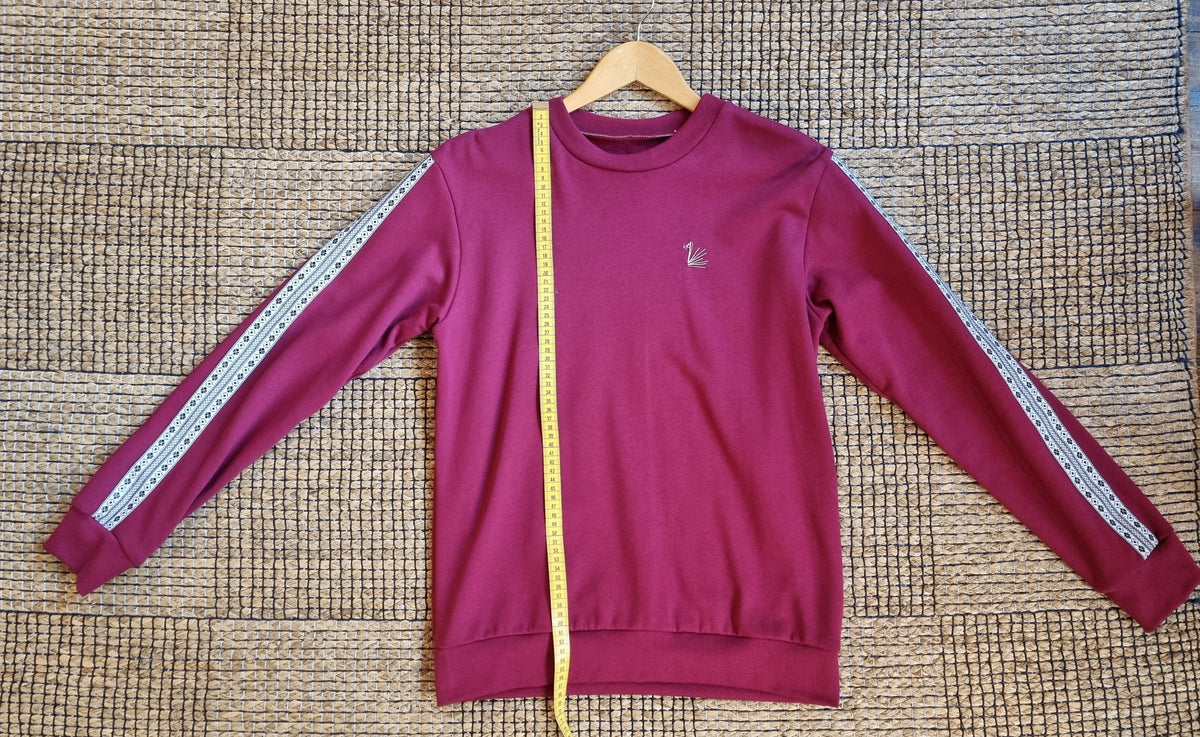
Using a few photos of a Basic sweater, I'll show you below exactly where to take these measurements on a garment of your own. And I'll explain how to measure them on your own body.
Chest

For tops, such as jumpers, sweaters, T-shirts and jackets, the chest measurement is what counts. I always measure it from armpit to armpit. See the photo above for an example. Lay the garment neatly flat, but don't stretch it. Then measure from armpit to armpit and multiply that number by two to get the full chest measurement.
Want to measure your own chest? Measure all the way round the fullest part of your chest, keeping the tape as straight as possible. Usually that's at nipple height.
Hips

As well as the chest, the hip measurement is important for tops too. Say you have quite a small chest but need a bit more room at the hips. Then it's no use if the piece fits well at the chest but won't go over your hips, or the jacket won't close there.
You measure the hips as shown on the Basic sweater above. Make sure the garment is lying neatly flat, but don't stretch it. Then measure the hem: the bottom edge of the garment. If a sweater or jacket has a rib band, like this Basic sweater, measure the seam where the band is sewn onto the sweater or jacket – and again, don't pull on it. Of course the hips will still have a little give, but you don't want the fabric to be under a lot of tension when you wear it.
To measure your own hips, place a tape measure around the widest point of your hips, keeping it as straight as possible. This is often where the softer parts of the body are, like your bottom and thighs, so don't pull the tape too tight. Keep it snug, but make sure it doesn't ‘dig in’ too much, if you know what I mean. So don't measure at the height of your hip bones: the widest point is usually a little lower, over your bottom or the top of your thighs.
Sleeve length

I always measure the sleeve length from the shoulder seam. Again, see the Basic sweater example above: measure from the seam where the sleeve is attached to the body down to the bottom edge. On this sweater, that's the bottom of the cuff.
The best way to measure your own sleeve length is to put on a shirt or jumper whose shoulder seam sits neatly on your shoulder. Then measure from that seam down to your wrist, or to wherever you'd like the sleeve to end.
Some sweaters, like the Room sweater, have an extended, dropped shoulder, which makes the sleeve look a lot shorter straight away. That's tricky to measure on yourself, because of course you don't know exactly where the sleeve will start on your arm. In that case, it's easiest to put on a top with a fairly high neckline. Then measure from the neckline of the top over the top of your shoulder and down your arm to your wrist, or to wherever you'd like the Room sweater to end. That tells me the total length I need to work with.
Length

I always measure the length of a top from the highest point of the shoulder down to the hem, the bottom edge of the garment. As you can see on this Basic sweater, by the highest point of the shoulder I mean the point next to your neck, not the point at the sleeve end.
Here's how to measure the length on yourself: start from the same point as in the photo above, but on the garment you're wearing, and measure straight down. The tape should run over your chest. Measure to where you'd like the garment to end. Is it an existing piece and have I sent you its measurements? Then measure to see where that length would fall on your body.
Trousers, shorts and skirts
The same principle applies to trousers, shorts and skirts, but different measurements matter here, of course. The hips are key, the waist is important and often the length too. So here are some tips and examples for these garments as well, so you can measure the piece – or yourself – as accurately as possible!
Length of trousers, skirts or shorts

I measure the length of trousers, like the Serene pants in the example, in two places: from the crotch along the inside leg seam to the hem, and from the waistband down the outside of the leg to the hem. You might be wondering: why two places? Because one pair of trousers sits really high on the waist while another sits low on the hips. That way we avoid any misunderstandings.
You measure the length of a skirt from the waistband straight down to the hem. With a skirt that hangs straight, it doesn't matter exactly where you measure, as long as you measure straight from top to bottom.
On yourself, you measure the length in exactly the same way as in the Serene pants example above: once along the inside of your leg and once along the outside, down to where the trousers should end at your ankle.
Waist and hips

With trousers, it's of course also important that they fit you width-wise. That's why it's handy to know your hip measurement if you're unsure about the size. As I described earlier, you measure it at the widest point of your hips. That's often just below your hip bones, over your bottom or the top of your thighs. My tip: stand in front of a mirror so you can check that you're really holding the tape straight, meaning parallel to the floor.
Your waist, on the other hand, is measured at the narrowest part of your torso. That's usually just above your belly button, but every body is different.
I'll then measure these for you on the trousers, shorts or skirt you have your eye on. Because they vary hugely from pattern to pattern, and especially depending on the fabric: how much stretch it has makes a big difference.
So there you go, lovely people – I hope that was a clear explanation! Still have questions? Don't hesitate to send me a message.


